Detailed info about our tech work
A timeline of how Ubiquta's approach to the operating system and the compute platform developed, from dual-boot workstations in 2010 to multi-node, heterogeneous compute today.
Alternate operating systems and multi-platform architecture
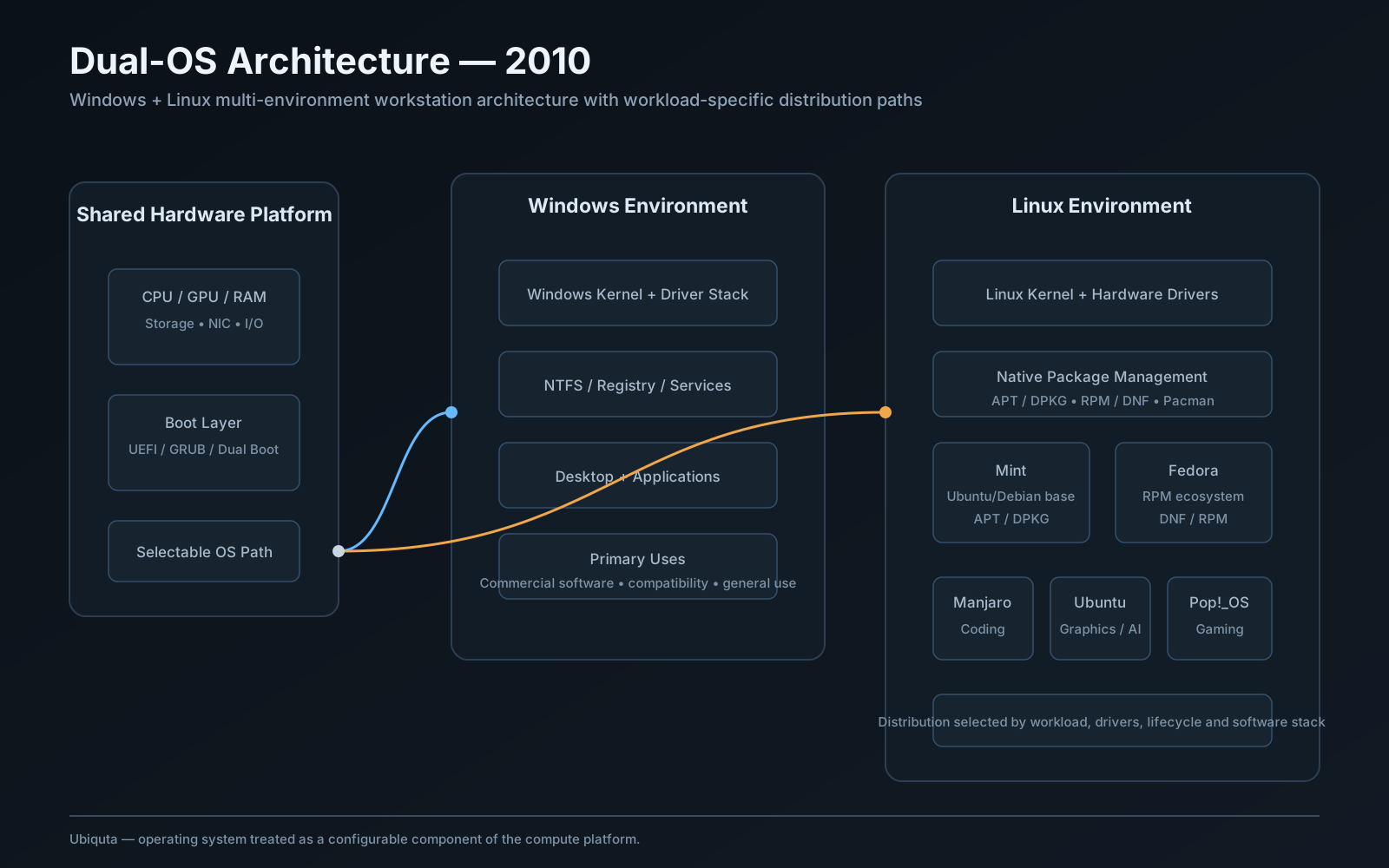
Began development and testing around alternative Linux operating systems, dual-boot hardware, and multi-environment workstation configurations designed to support both Windows and Linux on the same physical platform.
Early work centered on conventional distribution architectures such as Linux Mint and Fedora. Linux Mint, built primarily on the Ubuntu/Debian software ecosystem, uses the dpkg package format with APT-based dependency resolution and centralized repository management. Fedora follows the RPM ecosystem, traditionally using RPM packages with DNF for dependency management and system updates. These systems rely primarily on distribution-native package management rather than application isolation layers such as Flatpak, Snap, or AppImage.
This distinction became important in our architecture work because the operating system, kernel, driver stack, desktop environment, package manager, graphics subsystem, and software repositories all influence workload performance, stability, maintainability, and hardware compatibility.
Over time, Ubiquta moved away from treating one operating system as the ideal solution for every task and toward selecting Linux distributions according to workload.
A lightweight desktop environment combined with the Arch Linux package ecosystem and Pacman package management. Its rolling-release architecture provides comparatively rapid access to current compilers, libraries, kernels, development tools, and hardware support without requiring major distribution upgrades.
Broad compatibility with professional software, GPU drivers, CUDA libraries, development frameworks, and third-party documentation. Large package repositories and extensive commercial support make them useful when hardware and software compatibility matter more than the newest possible package versions.
Ubuntu-derived distributions can provide a streamlined graphics stack, strong NVIDIA and AMD GPU support, Steam and Proton compatibility, and configurations intended to minimize the manual system administration required before a machine can be used productively.
The operating system as a configurable component
Rather than forcing every workload into a single standardized operating-system image, the evolving Ubiquta architecture treats the operating system as another configurable component of the computing platform. The distribution can be selected according to the workload, hardware configuration, driver requirements, update model, security requirements, and expected lifecycle of the machine.
This approach also allows traditional distribution-native packages, containerized applications, virtual environments, Flatpak applications, Docker or Podman containers, and other isolation technologies to coexist where appropriate instead of requiring the entire system to depend on a single software-delivery architecture.
AI technology, heterogeneous compute and multi-node architecture
Research expanded into artificial intelligence, accelerated graphics, high-bandwidth memory utilization, heterogeneous compute scheduling, and the architectural problem of supporting multiple demanding workloads across the same hardware platform without requiring each workload to reside on a dedicated high-cost system.
This work included conceptual designs for systems capable of distributing graphics rendering, AI inference, model execution, memory-intensive processing, and conventional CPU workloads across a coordinated pool of compute resources. Particular emphasis is placed on improving utilization of GPU compute engines, VRAM capacity, system memory bandwidth, memory locality, data movement, shared workload scheduling, and the relationship between processing demand and available memory resources.
Rather than treating graphics, AI, and memory-intensive applications as isolated workloads requiring separate systems, the architecture began to consider them as schedulable components within a broader heterogeneous compute environment. GPU resources could be allocated according to workload type, memory pressure, latency requirements, thermal headroom, and current utilization, while system RAM and local storage could support staging, caching, intermediate datasets, model assets, and overflow workloads without unnecessarily burdening a single accelerator.
Affordability, redundancy, and component longevity.
This period also marked the beginning of a decentralized hardware strategy centered on affordability, redundancy, and component longevity.
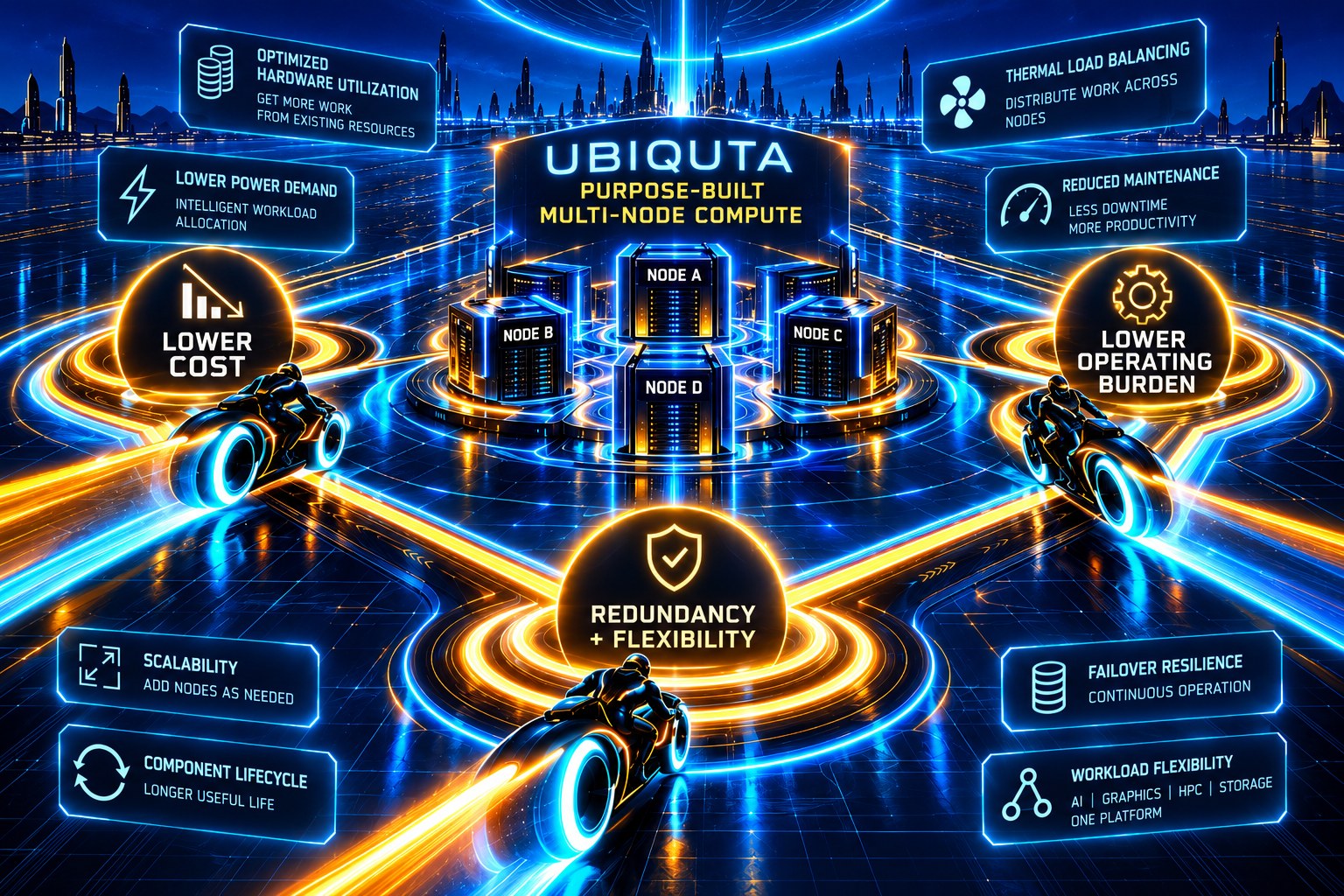
Instead of concentrating performance into one extremely expensive workstation operating continuously near its thermal and electrical limits, Ubiquta began conceptualizing multi-node systems in which workloads could be divided across several lower-cost compute platforms. Each node could be selected and configured according to a specific workload requirement, including graphics production, AI processing, development, simulation, gaming, memory-intensive workloads, or background services.
The economics of the system as a whole
The objective was not simply to increase aggregate performance. It was to improve the economics and operating characteristics of the system as a whole.
A distributed multi-stack architecture can allow individual processors and accelerators to operate at a lower sustained utilization level, reducing thermal stress, power density, fan demand, and prolonged high-current operation. Workloads can be shifted between nodes according to demand, allowing available hardware to absorb short-duration peaks without requiring every component to remain at maximum operating load.
This design philosophy produces a three-part benefit:
Compute capacity can be expanded incrementally using appropriately sized hardware rather than through periodic replacement of a single monolithic workstation.
Work can be distributed so that individual GPUs, CPUs, memory subsystems, power-delivery components, and cooling systems spend less time operating near their maximum sustained thermal and electrical limits.
Multiple nodes allow useful work to continue if one component or system is unavailable, while also permitting graphics, AI, memory-intensive processing, and general-purpose workloads to be assigned to the hardware best suited to them.
The resulting architecture is a purpose-built compute platform rather than a single oversized computer: multiple systems, multiple accelerators, multiple memory pools, and multiple software environments coordinated around the actual workload instead of requiring the workload to conform to one machine.